Leadership, Mental Health, Wellbeing and Decolonisation of the Curriculum Consultancy by Pran Patel 0203 0053212
Decolonise the Curriculum.
Decolonising the Curriculum, Equity and Action.
These Articles are designed to make you think. Everything from the day to day classroom to dismantling an ethnocentric curriculum on a national and global scale.
This week has been trying, with videos of racism, discrimination and propaganda being circulated widely by the mainstream and social media. Let me say this before I continue; I do not for one second believe that this a new wave, as a man of colour I have been inundated with communications and experiences for pretty much as long as I can remember.
The narrative is now being shifted and centred to the response to racism, the violence and the deaths:
Distraction.
Riots.
Violence.
Aggression.
Tone.
That’s somewhere else.
This shifting is a deliberate societal reaction. When you move the subject from moral injustice, this is a distraction and distraction is a function of white supremacy (Toni Morrison). In other words, if we are challenged personally or as a society, the last thing we should be doing is questioning the means of that effort.
There is also a frequent movement from the content of the challenge to an assertion about the person challenging. We end up palming off our responsibility by concentrating on tone, manner and personality of the person. In the effort of making the dealing of the content easier because you are no longer reflecting on those uncomfortable truths.
Let us begin with the narratives.
Rioting
Let’s start with the concept of rioting; the challenge is reframed if you have an oppressed group who are fighting for their lives at the hands of the state. When do you say enough is enough? Famously, Dr Martin Luther King Junior famous said that riots are the voices of the unheard, so I ask what are we not hearing?
We would do well in remembering that people have tried for millennia through articulate and respectful civility to fight this injustice. When they take to the streets through fear of losing their lives, they are branded the bad guys. Why is that? Why have we been trained to think this way? And ultimately, who does it protect? And do we teach this type of criticality in schools?
Looting.
Let’s look at the parallels our British Empire ‘looted’ in excess of $45’000000000000000000 ($45 trillion) that’s 19 zeros if you’re counting and continued to loot priceless historical artefacts worldwide and remember none of this has been returned. Today, the descendants of those people (who were the victims) are subjected to the worst society has to offer as a consequence of the British Empire and colonialism. Those are the people we are so quick to condemn. The hypocrisy is rich.
That $45 trillion figure doesn’t include chattel slavery either. Although, I will point out that our taxes until 2015 were used to pay reparations for slavery. Oh wait, let me be clear, those reparations were not to the enslaved people but the slave owners for their loss of stock. Yes, you read that correctly. During ‘abolition’ our country borrowed against the state to make these payments and our taxes finally repaid this debt in 2015. It is entirely possible that the lineage of people who suffered paid for their liberation. Not taught that in schools.
Isn’t America a terrible place, it’s racist, the devil lives there, etc. I am not disputing the institutionalise racism and inequity in the United States of America. Why is the narrative rarely about the UK? About our own society because it’s easier to point fingers and say we are better than them, well least racist is *shockingly* still racist.As the US narrative is about Police brutality and the state response. Let’s look at us closer to home.A Black person is ‘four times more likely to be sectioned under the Mental Health Act’. It’s not that simple there may be factors are in play; however, when coupled with the deaths of members of people of colour in police custody (6 out of 11 from 4/17-12/17) this isn’t looking great.With the chair of the IOPC saying ‘We need to look closely between the relationship between ethnicity and the use of force.’ Black people are proportionately four times more likely to experience force from the police five times more likely to have AEP or taser used against them and nine times more likely for officers to have used firearms. Stop and search also disproportionately targets Black people, to the tune of 40 times more likely to stopped and searched compared to white counterparts.
That was pre COVID-19 and Black and Brown people are 54% more likely to be punished under coronavirus rules many of these were charged on corona laws which do not exist.Today, The Guardian reports that the IPOC are investigating CCTV footage of a 15 years old being beaten by a police officer in the West Midlands. The same officer was caught on camera beating a Black cyclist and ripping his face mask off just the day before (he was held down by a female officer), Black men wrongly being shot, a Black man was tasered for witnessing a car accident, and it gets worse. Check the article in the references below.
“There is a sense in these communities that no one is ever held accountable after deaths and serious incidents. The test for the credibility of this IOPC investigation will be if something happens as a result,” Deborah Coles, the director of Inquest.
That quote is from the same article. This concept is prevalent as far as I know in the last 36 years, not one police officer has been charged for a death in police custody (happy to be corrected). Where is the justice?
As Educators, What Can we do?
Step one is to acknowledge that this exists in our system, in our country and that we are a part of it. There is nothing wrong with teaching an authentic truth which highlights the atrocities of our past and present I would say that this is a significant pivot point in the upholding of institutionalised white supremacy in the UK. Alas, I have found as educators through fear, guilt and uncomfortableness we either refuse to act or recoil and double down on more of the same.
Recognising our biases against pupils of colour are also critical with regards to behaviour as we know Black boys with SEND are 168 times more likely to be excluded when compare to a white girl without SEND. Teacher underassessment is also a pertinent point if you have a lower expectation for a pupil (at the longitudinal study say systemically we do) throughout their school life this impacts their outcomes.
I have written extensively on decolonise the curriculum, and you can find those resources on this website. I will write something for leaders too, at some point. Right now, I am exhausted, it is 2020 and people of colour have been asking for change, justice and fairness forever it feels.
Things that don’t make you immune to whiteness and white supremacy,
Dating a person of colour.
Engaging with friends of colour.
Loving ethnic cuisine.
Ascribing to another protected characteristic.
Learning and speaking another language.
Having PoC in your family
Being a good person.
Having good intentions.
Working with PoC for a charity.
Saying I’m not racist but …
Being a person of faith.
Loving world music.
Teaching in a school which is majority GM.
Being a feminist.
Having children of colour / having bi-racial children.
Believing that you are beyond denial.
Retweeting Black activists and theorists.
Announcing your white privilege.
Taking the lead on ‘decolonise the curriculum’ initiatives
‘Tolerating’ diversity
Being in an academic field i.e. African Studies, etc.
Putting up signs in different languages along the corridor in your establishments.
Holding stand-alone themed weeks (Chinese New year, black history (for one) month (only))
Forming committees to tackle racism or raise issues faced by BAME communities.
Being a person of colour.
Raising money for a specific charity Being a member of a specific organisation
Having siblings or family of colour.
My best mate is…
I once went to that country.
I work with/I went on a course once…I
hear what you are saying, but I have never been racist
I watched Roots, as a kid.
Holding a particular political viewpoint.
Being white and moving to a country where you are then a minority. Eg White people who have a gap year in SE Asia and claim to understand what it’s like to be a minority.
Travelling, growing up in different countries.
Enjoying and using fashions/textiles
Receiving approval for a single/few acts of solidarity/ally-ship
Wearing your hair a certain way.
All of the above attributes or actions do not provide us with a get out of jail card.
This post is from Dr Peter Olusoga, BPS Chartered Psychologist & Senior Lecturer in Psychology, Sheffield Hallam University. This piece can also be found here. Please do check out this piece he wrote for the Guardian.
The Trauma of Blackness – Police Brutality and Violence.
It’s been a difficult week.
I feel stupid even saying that, because unlike George Floyd, I haven’t had my last breath forced out of my lungs by a Minneapolis police officer taking a knee on my fucking neck.
Unlike Tye Anders, I haven’t been forced to lie on the ground by a sounder of police with their guns pointed at me and then arrested for evading arrest (whatever the shit that means), all because I allegedly rolled slowly through a stop sign.
I haven’t had some fucking racist douchebag call the police because he didn’t like seeing black people in ‘his’ building.
And I haven’t had to stand there while fucking Karen called the police because she’s a fucking racist. I didn’t have to listen to the entirely faked rising panic in her voice as she pretended to be under attack from “An African American man.” I didn’t have to stand there knowing full well that I could, at any moment, become yet another modern day Emmett Till.
None of those things happened to me… this week anyway. But I’ve seen all of those things play out, in glorious technicolour, on social media, various news feeds, you know, the internet. And that was only two days’ worth.
Tom Austin: A douchebag
Mobile phone footage, dash-cam footage, body-cam footage of the brutalisation, victimisation, the straight up, no-two-ways-about-it murder of black people. Right there in the palm of my hand, ready for me to digest at my leisure.
Fuck, man.
That shit takes a toll. And that’s why I have deliberately chosen not to link to any of those stories. If you want to see, you can go find them yourself.
Then there are the comments. Sweet Lordy Jebus, never read the comments. They’re precisely as predictable as they are dumb. But they’re always there. Without fail. Every time.
“What did the guy do before the footage started?”
“There must be another side to the story.”
“They must have been up to something.”
These comments usually come from people who insist that they aren’t racist, that they’re only being fair, and that it’s important to hear all sides before making a judgement. They can’t, or won’t, see that by ignoring all of the evidence that points to racism, and insisting that there must be some explanation other than racism, that they are literally perpetuating racism.
Okay let’s just pause there for a second. In the UK…
Black men more than 3x more likely to be arrested than white men.
In the year to March 2018, black people in England and Wales excluding London were 26 times more likely to be stopped and searched under a Section 60.
Combined figures for England and Wales show black people were 40 times more likely to be stopped, up from 14 times in 2017.
Between April ’18 and March ’19, there were 4 stop and searches for every 1,000 White people, compared with 38 for every 1,000 Black people. Despite this disparity, the rate at which prohibited items are found in these stops is broadly even across all ethnicities.
When a crime has been committed, black offenders are 44% more likely than white offenders to be sentenced to prison for driving offences, 38% more likely to be imprisoned for public disorder or possession of a weapon and 27% more likely for drugs possession.
Feel free to look up stats for other countries too – I’m not doing all of your work for you.
Despite evidence of a clearly racist approach to policing, the first comment upon seeing a police interaction with a person of colour is, “well surely he must have done something to warrant this treatment.”
If you think weapons drawn and screaming “show me your hands” – at a kid whose hands are clearly visible, by the way – is an appropriate initial response for running a stop sign, then… well, just fuck off basically.
To witness such hate, such violence against people of colour, to experience again and again the predictable denial of racism and the gaslighting that follows is to experience trauma.
I guarantee that those same people asking to hear both sides of the story would scream and shout about the sacred notion of being innocent until proven guilty, yet the appearance of blackness confers guilt in their minds, perhaps subconsciously, but perhaps not. The victims – and yes I have chosen that word deliberately – simply must have done something to warrant such treatment.
Maybe those commenters won’t see it because to admit that racism might be the cause would be to admit that racism might be the cause. Maybe they’re not ready to admit that they live in a racist society, but for the love of Tino Asprilla, what would it take for them to be ready? What has to happen for people to see it, because I have to say, I think we’re there already. There’s not much further to go.
And then there’s the shock and surprise.
“This is disgusting, I can’t believe it.”
“How is this happening in 2020!?”
Like, that’s lovely and all, but when you see this shit three times a day, how can you continue to be shocked and surprised by it. If I punched you in the face every day at 3 o’clock, it won’t take but a few days for you to start looking around at 2.59.
Yet somehow the comments would make it seem like this is the first time these people have ever seen racism. Maybe it is, but that kinda begs the question: what the fuck have you been watching all this time?
I’m not even going to bother with the #AllLivesMatter crew. That can be for another day. I don’t have the energy or the words right now.
Because all of this, all of it together, takes a toll on people of colour. It’s traumatic, and I don’t use that word lightly. To witness such hate, such violence against black and brown people, day after day, even from the comfort of your own sofa, to experience again and again the predictable denial of racism and the gaslighting that follows is to experience trauma.
And it caught up with me this week as I finally broke, and I sat in my kitchen and wept.
Anger ✔
Anxiety ✔
Sadness ✔
Sleep disturbance ✔
Overwhelming stress ✔
Helplessness ✔
Racism is a mental health issue.
My mental health has taken a battering this week. I’m unplugging for a while after this post goes live. I have to.
I don’t have the privilege of being able to say “oooh isn’t it awful” and then get on with writing my shopping list (in aisle order obviously) as if nothing has happened.
Instead, I’m forced to contemplate my own existence as a black man in this world. Forced to contemplate my own place, my own behaviour, my own fucking life.
It’s too much to have to do that all the time. It’s too big an ask.
So here’s what I propose.
How about you do it? If you’re a white person reading this, how about you contemplate my existence as a black person in this world? How about you contemplate your existence as a white person in this world?
Just for a bit. If it gets too hard, you can stop, I promise. But then maybe go back to it. Just see what comes up. And maybe have a think about what you could do.
Just a few days ago, yet another unarmed black man was killed by the police in the USA. Despite repeatedly telling police officers and passers-by that he was struggling to breathe, George Floyd’s last breaths were caught on camera, and have circulated the globe, serving as a reminder that all humans are equal, but some are more equal than others.
Tens of thousands of children across the globe have either seen the footage of George’s death, or are aware of not just the tragedy that occurred on the 25th May, but the many other black lives which have been extinguished at the hands of the police. It seems like only yesterday we were confronted with images of Ahmaud Arbery being ambushed and murdered.
The truth is, that after watching this latest video, reading comments on Twitter and reposting stories on Instagram, there will be some children who won’t know what to think. There will be some children who will be scared when their older brother, father or uncle leaves the house to go to work. There will even be some children who will hear their parents or other family members say, ‘He deserved it’.
The question is, what are we, as educators going to do about it? If we are serious about dismantling the systems of oppression that manifest themselves in many areas of society, how can we address these balances in our lessons?
Specifically, as a music educator, there have been many songs written in the last few years which have highlighted police brutality in the US. As with any song, we can analyse anything from harmony, melody, rhythm, and of course, lyrical content. By doing this, we not only address the injustice that we are all painfully aware of, but we subconsciously let children know that this music is just as worthy to study as a Beethoven Sonata or a theme written by John Williams.
Here are a few easily accessible examples which can help us to start to understand what the lived experiences are for black people in America, and how people of the global south see themselves in relation to these tragedies.
Over to you, teacher.
Hell You Talmbout – Janelle Monae ft. Wondaland Records
Nathan Holder is a musician, author and consultant based in London. He received his Bachelors from Anglia Ruskin University, and his Masters in Music Performance from Kingston University, while winning the MMus Prize for Outstanding Achievement. As a musician, he has performed with artists such as Ed Sheeran, The Arkells and Zoe Birkett, and performed in locations in Dubai, Bali, USA and across Europe. www.nateholdermusic.com
Recently we have had and a spate of racially motivated injustices. In the US the deaths of George Floyd and here in the UK police tasering a Desmond Ziggy Mombeyarara in front of his toddler. Let’s look at the way the system led to these acts that we all think are ‘abhorrent’. Yes, all of these incidents were videoed, documented and recorded, and no I will not tag the videos as BIPOC may be reading this, and I don’t want to exacerbate their trauma. I will say, however, that thank all that is good that filming now exists and gives us an indication of the injustices that go on around us.
One of the officers in George Floyd case Tou Thao, was allowed to punch and kick a handcuffed suspect ‘until his teeth broke’, there was a lawsuit that was settled out of court $25’000, now think, why was he was still an officer? Another police officer involved Derek Chauvin (below) has been investigated for three incidents; one including where a suspect was shot. It’s not looking good.
Desmond Ziggy Mombeyarara (below) was tasered in front of his child on a petrol forecourt. At the same time, on the ground he continued to be tasered, I await the victim-blaming responses to this piece because no matter what the reason from what we saw that was excessive, in front of his young child that was completely unnecessary. Due to a call by the Mayor of Manchester, Andy Burnham the IOPC are currently investigating the mobile phone and body camera footage.
I would point out that the victim-blaming of this man was almost as fast as the footage being released. No, I don’t care what the if the man being subjected to police brutality had been drinking and driving; he was the victim, again for the people at the back, HE WAS THE VICTIM. Scott Patterson (whose thread much of this piece is based on) expertly states and then asks that people drink and frequently drive how many white women are tasered, seen writhing face down while their child watches? This is a point I may come back to in a later piece.
Let’s put Desmond Ziggy Mombeyarara into context and humanise him after many were quick to make him an act. Mombeyarara’s partner and mother of the 5-year-old child, died in 2016 after the north-west ambulance service failed to provide “the most basic care” according to the coroner. After suffering a fatal allergic reaction to painkillers, she was accused of ‘faking it’ by paramedics.
Looking at the use of force by the police:
With the chair of the IPOC (police watchdog) saying ‘We need to look closely between the relationship between ethnicity and the use of force.’
Stop and search also disproportionately targets black people; You are 25.6 more likely to stopped and searched in Dorset and 17.8 times more likely in Suffolk; if you are black rather than if you are white (2016).
Combined figures for England and Wales show black people were 40 times more likely to be stopped, up from 14 times in 2017.
Bringing it back to 2020 and the global pandemic the first person to be charged under the corona legalisation was a lone black woman, Marie Dinou, in the northeast on false charges; Don’t worry I’m not going to make comparisons to others in lockdown.
Now, we have an analysis from the National Police Chiefs’ Council charges by the corona law. Yes, black and brown people are disproportionally charged more frequently, and when they are, they are fined more. As of the 15th May, “All 44 charges brought under the Coronavirus Act since it was introduced on 27th March were incorrect, the Crown Prosecution Service (CPS) has confirmed”.
My first point is that this is not the United States of America; this is the United Kingdom. This is us. The idea that at least we are not the USA or we are less racist is absurd, least racist is still racist. The process of deflecting to save ourselves denies we have a problem this further entrenches our societal position.
When a racial injustice happens, I see scores of white people condemning, offering their condolences and feeling physically sick at the thought of it. Let’s work this is through; The idea privilege comes from the premise that you leave your house and someone stuffs banknotes to your pockets (i.e. you have to apply for 80% more jobs if you have a Muslim sounding name to get an interview, same qualification, etc.) What people neglect to understand is that privilege comes from the oppression of the others, that money came from their pockets (Non-Muslims benefit from that discrimination) (Zeus Leonardo). White people benefit from the system we live within as do men, non-disabled people, etc. So, if you are ready to do something about it, I hate to tell you this, but we all had a part to play in those injustices.
All of the above incidents are not (or extremely rarely) caused by overt racism or hate. They are caused by the micro-aggressions (small daily indiscretions) which normalise the rhetoric and then the actions. Every time that a racist joke is told and you stay laughed or stayed silent, every time that you let a casual racist comment slide and all those times you didn’t want to ruin dinner because your racist uncle was talking crap lead to this.
If you normalise hate and othering no matter how small you create a base for this to build on, when you don’t challenge others, you contribute to the problem. When you question the validity of lived-in experience, you push us closer to the injustice. Yes, you and I are responsible.
This is the pyramid of white supremacy from Salisbury University. As you can see that the pyramid is based on the above interactions and without them the whole thing falls down. If you are interested in a fairer society here is some more reading about the racist to antiracist spectrum.
Now, put your anger and pity away – How are you going to disrupt this system? How are you going to stop the racism from its base? How are educating people to be different? Because if your answer is by airing you distaste on social media, doing very little, apathy or silence seriously you can keep your disgust because it is of no use and uphold the system leads to all of this.
This blog comes from Halil Tamgumus, a serving headteacher in Leicester.
Up until university, it is fair to say that education and I were not the best of friends.
We tolerated each other, but I didn’t get much out of the relationship.
There are many reasons for this. A large part of it, I feel, was down to the fact that education back then wasn’t aimed at engaging me. It didn’t take in to account who I am. I lost interest.
I remember the day I got my GCSE results as if it were yesterday. The envelope in hand; My mates all, and I mean all, screeching in delight. The hubbub of all the other “not quite children – nearly adults” a blur in the background, muffled by the beating of my heart in my ears. Deafening. I felt sick. I knew. I knew it wasn’t good news.
I opened it…
On my own…
And my fears became a reality.
I failed all my GCSEs.
Yep, that happened.
I felt sick; you know the feeling you get when your heart sinks into your stomach? My head was spinning.
Baba had asked me in the morning to go past the shop he was working in at the time and share my results with him. I considered not going, I mean in all honesty, I even thought about running away. But I did go because I knew if I didn’t, he’d be worried and I am sure if I was more than 30 minutes later than what we had agreed he would have galvanised the whole community and sent out a search party for me!
The walk there felt like I was moving in slow motion, the world around me put into fast forward but ironically before I knew it, I was standing outside the shop. Baba saw me straight away. I mean, I wasn’t exactly inconspicuous – at that time I was about 17 stone (I’m big-boned alright!).
He beckoned me in with a long arm gesture.
I shook my head.
I watched him pass the food he was preparing for one of the customers to his workmate. I read his lips as he spoke to him – kötüdür – simply translated – ‘It’s bad’!
By the time he got outside, I was leaning on our family car; my legs had gone to jelly (insert weight joke here 😊). I mean, seriously, what was I going to say?
He stood in front of me, and as far as I was concerned, it was just him and me – the world around us melted away. I took a deep breath. Opened my mouth to speak and before I made a sound he said in the calmest and sincerest of tones
“it’s going to be alright son, I love you”.
I sobbed uncontrollably. I couldn’t catch the air around me quick enough to feed my lungs. It was as if I was on top of a mountain where the air is thinner.
I didn’t cry like that again until almost 20 years later. It came as a delayed reaction to the news from the consultant that my father had months to live. Ironically, I was outside a Turkish restaurant while leaning on my car and my sister standing by my side telling me she loved me.
I’ve wiped the phone of my tears several times; the last few paragraphs have reminded me just how much I do miss him.
Our next exchange of words influenced me in such a profound way that it had become part of my being; it changed my outlook on life; it prepared me for what was to come.
It was one of two critical moments in my life regarding my father guiding me through education. The other was just before I went to university (another blog for another time).
He asked me “what are you crying for?” My response – the crux of my pain – “I’ve let you down – I’m so ashamed”.
“My son, you haven’t let me down! You could never let me down. Tell me what you want to do?”
“I want to retake my exams Baba” I couldn’t give him eye contact, my eyes firmly fixed to the pavement.
“Ahh yes… There you go” he placed a reassuring hand on my shoulder while gently tilting my head up with his other hand under my chin. He was smiling and smiling with his eyes. He had the kindest eyes.
“You are a clever boy. Don’t give up. People will tell you you can’t do this and you can’t do that. Fight! That makes me proud”.
He endured a lot of “you can’t” and “you don’ts” in his heartbreakingly short life especially while he was trying his best to provide for his family in a country where he was, in the main, not made to feel welcome.
He never gave up, right until the end.
I don’t give up. Yes, I’ve had to work hard to get to where I am. Some may argue I’ve had to work harder than expected. But I never gave up.
Those of us who have had the misfortune of being on the receiving end of racisim, through no fault of our own but the fault of inequitable systems, have had to fight harder to get to where we are.
We never give up!
Some of those people who do not experience this see this perseverance as “confrontational” or “arrogance”.
Look a little closer and you’ll see the scars – the constant reminders of the battles we have had to endure to get to where we are.
Black and brown people are dying at higher rates due to Covid-19. There are various sociological traits which make people of colour more like to contract and die because of the virus. Instead of recognising that these exist inequities exist, it seems as though the world has decided to obfuscate and distract from the real issues.
The apparent trend here is
Denial: Remember the rhetoric around ‘The virus doesn’t discriminate’. How long did it take for the statistic to be released? Ask your yourself why?
Victim blaming: Black and brown it’s down to personal choice; diabetes and obesity are down to eating habits.
Distraction: BAME and PoC are more susceptible due to the vitamin D deficiency.
Eugenics: These deaths are because brown and black people are genetically inferior.
The above steps are almost straight from the eugenicist handbook. Let people die, blame them and their choices and further your agenda.
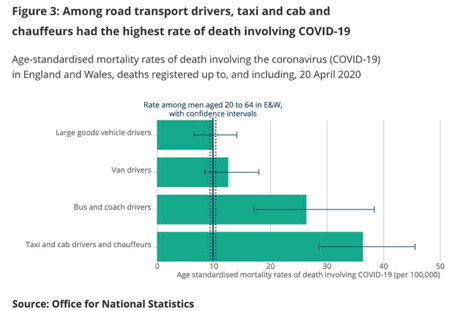
What’s actually going on. Yes, there’s a link between being BAME, deprivation and diabetes, etc. BAME/PoC are also as likely to be doing the jobs that place them in danger; couple that with the fact that PoC are more like to live in deprivation and this leaves people having to choose between rent and their health. Here is an article which states that 1:7 Pakistani men work as taxi drivers 1:100 white British men. Social care workers, security guards also more likely to be people of colour.
The vitamin D levels impacting on the immune system has had it’s links as a brown man, I think I’ve known about the link between Vitamin D and our melanin for most of life. Since the 60s Ricketts and a basic science is nothing new. However, If vitamin D impacts our immune systems so badly, why does it take a global pandemic to highlight this? Do we not matter? Did we ever?
Now to the problem with all the deductions from this data, it is all based on the fact that higher death rates are based on the premise that we are all treated the same in hospital and by society. I can hear people protest through the computer screen. Here is a government report
The NHS is not an institutionally racist organisation, Pran, come on that’s a stretch these people are our heroes. Yes, I agree that these people put their lives on the line, that does not preclude any organisation from systemic damage. Let have a look at complaints against medics of colour, shockingly they are disproportionate, reported bullying is higher, civility in the NHS is a factor for saving lives.
Here is some more reading there are a disproportionate number of referrals of BAME doctors in fitness to practise processes, these could be driven by poor induction and support, working patterns which leave them isolated and poor feedback by managers, research commissioned by the GMC has found. From the same study, some groups of doctors are treated as ‘outsiders’, creating barriers to opportunities and making them less favoured than ‘insiders’ who experience greater workplace privileges and support.
This guest article comes from Char Aramis, who is a non-binary primary NQT in the South West of England.
As society becomes increasingly inclusive and accepting, it is becoming apparent that there are more and more openly trans people out there. Almost everybody in the UK will be involved with a school at some point in their lives – many multiple times – first as a student, then as a parent, and maybe also as a member of staff or a governor or volunteer.
64% of trans pupils have been bullied at school because of their identity;
77% of LGBT pupils have never been taught about or discussed ‘gender identity’ or what ‘transgender’ means;
only 3% of LGBT pupils know of an openly trans member of staff;
44% of trans pupils say staff at their school are not confident about what it means to be trans;
33% of pupils are not known by their chosen name at school;
58% are not allowed to use the toilets they’re comfortable in.
And that’s just among pupils! The British Survey of Social Attitudes 2017 found that 21% of people think suitably qualified trans people probably or definitely should not be primary school teachers.
However, the Public Sector Equality Duty (Section 149 Equality Act 2010) (PSED) subsection 3c states that public authorities need to “encourage persons who share a relevant protected characteristic to participate in public life or in any other activity in which participation by such persons is disproportionately low”. Being trans falls under the somewhat problematically named protected characteristic “gender reassignment” and trans people are definitely underrepresented in education, so we should be doing what we can to actively encourage trans people into the teaching profession.
Given that we are situated within a society that is at best indifferent and at worst openly hostile to trans people, what can schools do to show that they are actively welcoming to trans people, be that as pupils, parents or staff?
NB: It is impossible to be trans-welcoming without being LGBT+-welcoming. Many of these ideas will address both aspects, but there are also things that can be done to specifically be welcoming to cis LGB+ people. I will not be discussing those here. Also, many of these actions could also be taken by other organisations, institutions and businesses.
It is important to note that these are not just things to do in writing – in fact, they will nearly all require some serious work on the part of the school – but rather they are things that are likely to be prominent on the website or on paper documentation (e.g. prospectus) and which will make a school’s public face more welcoming to trans people.
1. Explicit Commitment to Inclusion and the Celebration of Diversity
This is the kind of thing that should be in your school’s motto, vision statement or similar. It should be right there in the first sentence after “Welcome to Our School”. The first line in the “Message from the Head”. This is our school and we are committed to inclusion – or something to that effect. Even better would be to include – here or slightly later on – explicit clarification that this includes LGBT+ people, identities and issues. An open acknowledgement of the inclusion of trans people would be top tier (too many people seem to forget what the T in LGBT represents for the initialism on its own to be quite enough).
2. Explicit References in Policies
Include explicit references to trans people in your diversity and inclusion policy/ies, your sex education policy, your PSHE policy. Including explicit references to the PSED will also show you have made yourselves aware of your responsibilities to inclusion and equality.
3. Have a Named D&I Governor
I’ll be honest, I don’t know as much as I should about school governance, but having a named governor for diversity and inclusion shows a commitment to looking carefully and critically at how your school runs and doing the work. Also, a named D&I governor who really cares will ensure you really are looking carefully and critically at how your school runs and doing the work.
4. School LGBT+ Inclusion Award/Stonewall Champion School
These are good not only because, once awarded, they show your commitment to LGBT+ inclusion, but also because they will give you the support and resources to help you make your setting more inclusive and welcoming.
5. Curriculum
This section refers to the curriculum in the broadest sense – the things in your curriculum statements and policies. Think about where you can include topics on trans inclusion – mostly, on this level – this will apply to PSHE, but could you have a history topic on LGB and trans rights?
6. Gender-Neutral Uniform
I was debating which section to put this in, but this is something that is most apparent when it is set out on the website or in the prospectus, plus I will usually check how a school lists their uniform on their website if I am considering working with them, so here it is.
Having a gender-neutral uniform does not mean only offering trousers and shorts for everyone. It means offering trousers and shorts and skirts and dresses for everyone. Cardigans and sweatshirts for everyone. If you want to have rules about minimum hair length or what hair needs to be tied up that’s up to you (though you should bear in mind other discussions about this regarding racial discrimination), but these shouldn’t be “boys’ hair must be a minimum of a number 1 and girls’ long hair must be tied back”. If any hair must be a minimum of a number 1, all hair must be, and any long hair tied back. Boys’ hair definitely shouldn’t be limited to collar length, for example, if girls’ isn’t.
Physical Environment
These are the things that will show up in photos of your school and will be visible to anyone who visits or walks around your school. This is the stuff that is important both for those who will potentially become involved with the school in the future and those who are members of the school community.
1. Gender-Neutral Toilets/Changing Rooms
This is the big battleground when it comes to trans rights. Let me be clear: you do not have to get rid of all gendered toilets/changing rooms in your school. There are numerous cultural, social, religious and personal reasons why young people might want to use single-gender spaces. However, there should be gender-neutral facilities easily accessible for anyone in the school (one gender-neutral toilet in a distant corner is not sufficient).
If your school infrastructure allows (or if you’re lucky enough to be building/renovating your school building), self-contained individual toilet/changing cubicles can make this a non-issue.
2. Resources
This links in with the curriculum elements of this post and refers to any visual or written resources you are using. Are you only using images of gender-conforming people? What pronouns are used in your written resources?
A key area of focus is the school library, or wherever children’s reading books are kept in school. These books should portray a broad range of experiences generally – think about the diversity of writers and characters in your school reading materials – including trans experiences. See my blog post here for my thoughts on a number of fiction reads including trans characters, including rough reading ages and maturity levels. There are also non-fiction books such as I Am Jazz and Free to Be You and Me (disclaimer: I haven’t read these myself yet). I will try to expand these lists over time.
3. Displays
Dedicate displays to showing your commitment to inclusion. These can include factsheets and information, images of and information about role models, pride flags and other related imagery, and student work about/including trans people – such as that created in lessons described in ‘Curriculum and Lessons’ below. Make the presence of trans people normal in your school.
School Culture
This is the kind of stuff that’s probably going to make the biggest and deepest difference long-term, but it’s less apparent to outsiders or visitors. This is the stuff that will make sure trans people continue to feel welcome once they’re already part of your community.
Here I’m talking more about including references to trans people in your ‘everyday’ curriculum. Try to include a ‘golden thread’ of trans inclusion through your curriculum. I’m not just talking about assemblies and PSHE lessons (though do those too), but every subject, if you can. Just normalise it – even simple things like including people who use they/them pronouns in word problems in maths, to get pupils used to reading and using those pronouns in that way.
Include trans people in your lessons. If you’re looking at people involved with a certain topic or field, try to include at least one trans person. Granted, there aren’t many high-profile trans people outside of activism and media personalities, but after a bit of digging, here are a few to get you started:
The Wackowski sisters (Film, Media)
James Miranda Barry (Medicine)
Chris Mosier (Sport)
Charlie Martin (Motorsport)
Alan L Hart (Medicine)
Roberta Cowell (Motorsport)
Fox Fisher (Film, Media)
Juno Dawson (Literature)
Billy Tipton (Music)
Laura Jane Grace (Music)
Meredith Russo (Literature)
Write biographies of these people and include them in displays. Having role models is vitally important to young trans people. It is important for them to see that they can succeed in a variety of fields. It is important for them to see, simply, that trans people can grow up to be successful adults.
2. Language
This is simple and important but may require a change of lifelong habits. If you hear someone use the wrong pronouns for someone else, politely correct them, regardless of who else is or isn’t around to hear it. Normalise asking for another person’s pronouns when you meet them, along with their name. Offer your pronouns when you introduce yourself, along with your name. It is far easier and safer for you to do this as a cis ally than it is for trans people to do themselves.
Also, avoid gendered generalisations and stereotypes, but also avoid assuming the gender of any unknown or hypothetical person. Get used to using ‘they’ when you’re referring to anyone – real, fictional or hypothetical – whose pronouns you aren’t 100% sure of.
In the past, the media have often reported policies such as these as an attempt to ‘ban’ all gendered language, such as ‘he’, ‘she’, ‘girl’, ‘boy’, ‘woman’ or ‘man’. I am not suggesting that at all. Call girls ‘girls’, call men ‘men’, use ‘he’ and ‘she’ to talk about people who want to be referred to as ‘he’ or ‘she’. But only use those words in those senses. If someone told you they were going furniture shopping, you wouldn’t just assume they meant chairs, because there are so many other types of furniture. You wouldn’t call all furniture ‘chair’ because ‘it’s easier’. That doesn’t mean you’ve banned the word chair, you’re just only using it to refer to the thing it describes. Which is just common sense, really.
Another time to be aware of your language is in sex education lessons. Try not to refer to certain body types or features as ‘male’ or ‘female’. Of course, you want the children in your class to understand their bodies – but that includes the trans children true. The words ‘most’ and ‘usually’ are your friends here: ‘most women have ….’; ‘this feature is usually found in men’. You do not have to deny any correlation between bodies and gender – the percentage of bodies that do conform to the usual expectations is in the very high 90s – but it also leaves room to make it clear that there is some variability.
3. Staff Training
Ensure all staff, including your admin staff, your kitchen staff, your governors, are trained on what it means to be trans, experiences trans people go through, how trans people are and should be treated and what the law says with regards to trans people. Provide safe spaces where they can unlearn things they may have picked up through their lives, where they can practice and familiarise themselves with using new and unfamiliar language.
4. An Ethos of Acceptance and Respect
This is more an aim and a result of everything else rather than an action as such, but it is important that your school has an ethos of acceptance and respect that extends to every single person, which is explicitly taught, modelled and maintained.
5. Pupil Involvement
Involve pupils in building this inclusive environment by having pupil inclusion champions, who perhaps have responsibility for leading assemblies, promoting inclusion on the playground and acting as inclusion role models to the rest of the school. Also, give opportunities for practices and policies to be informed by pupil voice.
6. Parental Involvement
Provide opportunities for dialogue with parents, where they can be informed of the reasons and rationale behind choices and where they can have opportunities to raise questions and express concerns. Of course, it may be necessary to stick to your guns on unpopular policies in the name of acting in line with the Equality Act and the PSED, but it may still be good to get parental input in certain choices where possible to keep them on board.
I am currently in the process of organising an online conference on this subject and do hope you can join myself and some incredible, award-winning contributors including Nitin Sawhney (nitinsawhney.com) Pran Patel (theteacherist.com) Michelle McCauley (Decolonizingthemusicroom.com) and Nate Holder (nateholdermusic.com) on 13th May at 3.00 (watch this space)
In this blog, I wanted to outline my motivations for organising such a conference, some of the topics covered and some thoughts from some of our fantastic speakers.
A few years ago, I attended a conference for Primary school music specialists. A superb gospel choir came to perform for us, and two things really struck me. The first thing was seeing committed atheists, bouncing around the concert and heartily singing about how much they loved Jesus! The remarkable power of music to bring diverse people together. However, I became aware of something else that day, which I really couldn’t believe. Almost everyone in the audience attending the conference was white, and the choir had only one non-white member. I checked the date and the time. It was indeed Britain in 2017, rather than Alabama in the 1930s. In a multicultural society like Britain, how on Earth did this come to pass? I am good friends with the organisers, and they are not only very liberal but also very welcoming and inclusive to everyone. Does the fault lie with them? I don’t think so. Unlike 1930s Alabama, there were no signs saying “whites only”. No overt racism. It was clear that it was something more insidious and structural.
A few weeks later, I spoke at a very high profile music education event, sharing my work at Feversham, working with a 98% EAL intake, mostly from a Pakistani/Bangladeshi background. After my talk, two Asian teachers approached me. One was in tears, overjoyed to see BAME children receiving such a thorough music education, and we discussed how sorely under-represented BAME voices are in the sector. I was curious – just how many primary music specialists come from such a background?I know that they are many people from BAME backgrounds working in secondary schools as music teachers or peripatetic instrumental teachers. There are also many in primary schools who have been appointed “music co-ordinator” – however, they were not “music specialists” and define themselves as “non-musicians” – they were selected on a short-straw-drawing basis – perhaps for their management/organisation skills. They have not been trained as musicians, nor as music teachers. I put a call out on Twitter to see if there were any music specialists from BAME backgrounds working in primary schools. The results were interesting. I discovered two BAME music specialists this way – despairingly, they were the same two teachers who had approached me, in tears after my talk! This was not exactly a scientific study. I would love to be wrong about this. There clearly must be more than the two people I could find. However, it became clear to me that BAME educators are sorely under-represented in my niche professional sector. The workforce of music teachers in secondary schools seems to be more diverse, but not much more.
My school happened to be putting on a conference for BAME leaders in education, so I tagged along, and over lunch spoke to attendees about their experiences in music education. Lots of them had had a fantastic experience of music education, but it became clear that this was happening outside of their school life. Most felt like music in schools was “not for them”, and they were grateful to be able to fill those gaps by attending churches to receive their musical education.
Around a year after this, after a year of several keynote talks, mostly to exclusively white audiences, I was asked to do a presentation on the importance of teaching about “black” music for “Black History Month”. I did not feel entirely comfortable with this – surely this is not a job for a white guy from Leeds? However, it became clear that the organisers had had the same problem as me – they were completely unable to find any BAME primary music specialists! So, on this understanding, I agreed to do the talk. I did feel very “white” at that point, and as the audience were health care professionals rather than music teachers, for once my audience was diverse.
I was relieved that the talk was well received. The audience didn’t care that I was a white guy talking about all this, they were just grateful that the issues were being discussed at all. Also, I was in no way disingenuous. Whilst I love the music of Tchaikovsky, Rachmaninoff, Beethoven, Chopin and Debussy in particular (I’m a Romantic at heart) my musical heroes are mostly black – Fela Kuti, Nina Simone, Miles Davis, Duke Ellington, John Coltrane, Herbie Hancock, Parliament Funkadelic, Jimi Hendrix – or Asian – Nitin Sawhney, Talvin Singh, Ravi Shankar, Nusrat Fateh Ali Khan, Karsh Kale. I would listen rapturously to all this stuff, trying to emulate the wonderful sounds from the privacy of my bedroom. Meanwhile, my friends (who were all white, in the Lincolnshire market town I grew up in) listened to Coldplay, Travis, Blur, Oasis – all quality acts but they just didn’t move me in the same way.
The only band I could find to play in was a punk band – over whose driving thrash I would interweave elaborate and ornate piano parts. The NME described my playing as “ironic”. It wasn’t meant to be – I was just a square peg in a round hole. Meanwhile, my piano teacher discouraged me from pursuing jazz and improvisatory work. It just wasn’t needed for the ABRSM classical piano exams I was jumping through. So I have some sympathy with musical outsiders and with the BAME leaders who felt that formal music education “wasn’t for them”. I was staggered when I discovered you could actually study jazz as a degree.
So I had my formal education and my informal musical education. There are many accounts of how, in the days of US Slavery, a parallel musical community emerged amongst the slave population. According to David Metzer,
Christianitytoday.com explains how “Regular Sunday worship in the local church was paralleled by illicit, or at least informal, prayer meetings on weeknights in the slave cabins…Slaves forbidden by masters to attend church or, in some cases, even to pray, risked floggings to attend secret gatherings to worship God.
His own experience of the “invisible institution” was recalled by former slave Wash Wilson:
“When de n**gers go round singin’ ‘Steal Away to Jesus,’ dat mean dere gwine be a’ ligious meetin’ dat night. De masters … didn’t like dem’ ligious meetin’s so us natcherly slips off at night, down in de bottoms or somewhere. Sometimes us sing and pray all night.”
This was the birth of jazz and popular music as we know it today. Perhaps to call this “Black Music” is an over-simplification. Although rooted in the music of slavery, it was a fusion of a range of cultures; the driving rhythms and expressive vocalisations of African communities, the Western classical and Gallic influence of French colonists, songs of slavery and marching music.. The first jazz record, “Livery Stable” was in fact created by Sicilian band leaders whose parents immigrated because of the fruit trade. It’s interesting to compare the music of two giants of this era the “Louis” – Armstrong and Prima. Despite sharing a first name, distinctive gravelly voices and often producing almost identical sounding music, Prima was a white man born to Sicilian parents whilst Armstrong spent his youth in poverty in a tough black neighbourhood known as “The Battlefield”. Meanwhile, The New Orleans musician Jelly Roll Morton considered the Cuban influence of the tresillo/habanera rhythms (which he called the “Spanish tinge”) to be an essential ingredient of jazz. For me, this is music at its best – inclusive, vibrant and alive in the community, bringing together the participants to create art which is greater than the sum of its parts.
Almost all of this can be heard in one piece of music – Duke Ellington’s “Black and Tan Fantasy”. Quotation of a traditional American hymn, “The Holy City” suggests hope for racial equality. The major key original is transformed into a minor key, and features the kind of elaborations and expressions outlined above by Metzer. The second section uses the more “Western” sounding harmony, before returning to a trumpet solo with further elaborations based on what Ellington called his “Jungle Sound”. If the opening contained grains of hope for a positive future for racial equality, this is thrown into sharp contrast by the quotation of Chopin’s Funeral March as the finale to the piece.
In contrast to the “melting-pot” of New Orleans, the history of classical music is mostly one of exclusion . According to James Doeser, in the US, “the proportion of non-white musicians represented in the orchestra workforce – and of African American and Hispanic / Latino musicians in particular – remains extremely low. The wider orchestra field – conductors, executives, staff, and board members – also remains predominantly white. In some cases, such as among conductors, there are indications of positive change; in others, there is an absence of change”.
Sheku Kanneh-Mason is a phenomenal musician who has given hope to many BAME musicians interested in pursuing a career in classical music. An exceptional cellist, he won BBC Young Musician of the Year in 2016 and last month was honoured with “Best Classical Artist” at the Global Awards 2020. However, his upbringing was far from a typical experience for black British youth. Being born to a financially secure middle-class family (dad is a luxury hotel business manager, mum is a university lecturer) inevitably gave him some advantages. However, this was not the key factor in his success. His parents went out of their way to provide every musical opportunity for him as a child, giving up their weekends and travelling hundreds of miles to transport their children from one musical opportunity to another. He also was very fortunate to have an incredible music department in the state school he attended, which his family speak fondly of. It’s heartbreaking to hear his mother, Dr. Kadiatu Kanneh-Mason, talk about how that school music programme no longer exists, hoisting up the drawbridge to cut off such opportunities for the next generation. Sheku donated £3,000 to the school so that children following in his footsteps could continue cello lessons. This is symptomatic of a wider problem which affects all music in the UK – an education system which is seeing music education decline so steeply that people from all walks of life are affected. Discussing issues like “decolonisation” and “inclusivity” are something of a moot point if a music programme doesn’t even exist in a school! We should also consider what may have happened if he had been pushed away from classical music based on racial assumptions.
The issue of ethnic diversity in the music curriculum gained publicity in the Stormzy vs Mozart debate which raged on social media. Unfortunately, I found most of the discussions to be somewhat reductive on a number of fronts. Firstly, Stormzy is not representative of all non-Western Classical music (and nor is Mozart fully representative of the richness of classical music). I often read the debates whilst contemplating what any of this meant to the Muslim Pakistani/Bangladeshi community I serve. I was also a baffled onlooker throughout all the binary debates on Twitter – “knowledge vs skills” “child vs teacher led” “exploration/discovery learning vs direct instruction” – I’ve always tried to have my cake and eat it by including all of these in my pedagogy. I was equally baffled by people at either end of the debate who were advocating for NO classical music or ONLY classical music to be included in the curriculum. Like food, I think we need a balanced and varied diet. When I pointed out that I would be appalled by a school only offering classical music, a leading music education academic responded with this comment:
I was blown away by this statement. It’s a big insult to the majority of musicians from around the world who are “non-classical” musicians, but sadly typical of the elitism of many in the classical music world. You may not like Miles Davis, but to call him a “cheeseburger” is an insult to the majority of musicians from around the world. However, thankfully, I don’t think such attitudes are prevalent amongst music educators.
Conversely, a curriculum which would deny opportunities in classical music to children is equally problematic. I know of schools which teach Nasheeds to Muslim children but give them no opportunity to learn about the great classical composers.
As outlined previously, primary music education is dominated by white people (look at the ethnic/social diversity of the DfE’s Model Music Curriculum panel which I was a part of as a prime example of this). However, that is not to say that most music teachers are somehow racist, insensitive or disinterested in cultural diversity. Quite the opposite is true. Thankfully, we rarely see pieces like this, which were common in my youth, being part of the curriculum:
n fact, we see the sheet music market now making real efforts to be diverse – a quick Google of “multicultural songs” bring 11,000,000 results. However, I would argue that a “diverse” and “multicultural” curriculum does not go far enough. If the classical/traditional British folk music is enhanced with songs from Ghana and South America, what relevance does that have to British Pakistani children? Including a song from Mali in your curriculum is all fine and well, but if the African child in your class is from Kenya, will it speak to their cultural roots?
The first school I worked in (many moons ago) had a large intake of British Pakistani children, and were given a rich diet of music including Bollywood and Bhangra. Whilst both genres are hugely popular in Pakistan, a minority of British Muslims see music as being “haram”. At Feversham, we have found that such families are more than happy to attend Nasheed concerts at school – they either see this genre as being a halal form of music, or don’t consider it to be “Music” as such, in the same way that the call to prayer is not considered to be “singing”.
In his talk on “Decolonising the Music” Curriculum, Nate Holder looks at the AQA GCSE syllabus. At the top of the repertoire list are classical orchestral works by Beethoven, Haydn and Mozart. These composers are given a specific name, and a specific ensemble – there is nuance, recognising that a piece written for a string quartet is a different subgenre to a symphonic piece. Further down the list we have “Fusion music incorporating African and/or Caribbean music”. Not only is African and Caribbean music conflated, but “we know that the Caribbean consists of 13 different countries and territories, each island with its own unique way of expressing itself through music. When we think of Africa being comprised of 54 different countries, each country with many different peoples and tribes, to call something’ African music” is kind of strange.” We see “African Drumming” groups in UK education all the time. How often do we see someone running a “European String Group”? We don’t do that because we are very specific. Also, when we explore the choices of “World Music” in our syllabi, the popular genres, from Indonesian Gamelan to Gambian drumming are the products of former colonies.
OFSTED and the DfE often speak of “Cultural Capital” as something we as teachers must provide for children. This is fraught with issues which could have a negative impact on society. The term “Cultural Capital” was coined by Bourdieu, who argued that the primary function of education is to sustain the culture and privilege of the dominant groups in society. This is similar to Althusser’s view that schools act as “ideological state apparati” – embedding dominant ideologies in the minds of children. Given that Bordieu saw cultural capital as being rooted in the arts, it is perhaps surprising that the arts are not seen as a core element of education, despite great thinkers from Plato and Aristotle to Biesta arguing the case.
Given that the DfE’s interpretation of cultural capital is closer to Hirsch’s model of “Cultural Literacy” than Neo-Marxist models, this means children are seen as being mostly devoid of cultural capital, and our role as educators is to “civilise” society by teaching them, in Arnold’s phrase, “The best of what has been thought and said”. Given that history has largely been written by white men, this brings up the question – “thought and said by whom?”. And how is “the best” defined (it may surprise many people that the best selling poet in America is not Robert Frost or Walt Whitman, but the Sufi poet Jalal ad-Din Muhammad Rumi) The idea that children are cultural blank slates which need to be filled with the right kind of knowledge can be racially problematic if we see our children as uncultured, “savage” minds which need to be civilised. It is also problematic when viewed through the prism of critical race theory – the idea that “white ideology, values and interests are at the centre of all aspects of culture and policy”
Holder makes the point that very few individuals are actively racist and seeking to propagate “white ideology”. This isn’t about individuals, but structural oppression.
This is one of the things which makes challenging assumptions a difficult task. As a white man who makes the effort to be inclusive of other cultures, it can be upsetting to be challenged in this way., leading to denial and defensiveness (“some of my best friends are black”). However, whilst not being a racist individual, I have committed racist acts, albeit in ignorant good faith. For example, until recently, I was using the songs “Canoe Song” and “Land of the Silver Birch” in my repertoire. I thought they were perfect for my curriculum – “multicultural” songs with great pedagogical value. It took a plea from a Native American, Michelle McCauley, for me to realise that these songs actually reinforce racial and colonial thinking.
“[These songs] are not in any way representative of Native tribal music. These songs do not follow any type of drum beat or use melodies that are found in Native tribal music today and are an example of a lack of quality music that exists for music educators to use. As a Native American music educator myself, I cringed the first time I heard these songs because I know the stereotypes they affirm, and because I know that there are better examples of partner songs that do not further stereotype music that only reinforces ignorance of a mischaracterised culture.”
When I put these points to white British educators, some become very defensive, keen not be seen as the slightest bit racist, or worse, seeing it as “political correctness gone mad” It takes humility and understanding to begin to redress the imbalances. Pran Patel, author of the website “Decolonising the Curriculum” said something which really stuck with me. He described himself as a “white supremacist”. I f a person of colour can accept his role in reinforcing the racial status quo then it should be easy for me to.
We are fortunate to live in a connected world. I can check the meaning or pronunciation of a Kenyan song with someone who is actually from Kenya by contacting them online – not so easy back when I was growing up in that internet-free Lincolnshire market town. As McCauley states
“Learning about our music in a way that is authentic, rather than continuing to propagate stereotypes and further spread misinformation, is an integral part of being a culturally responsive and respectful music educator. It’s also easier than it’s ever been”
I’m in the wonderful position of having lots of pupils from BAME backgrounds who harbour ambitions to become music teachers. Whilst it’s almost inevitable that many will grow up wanted to do something else instead. However, I hope that if they do decide to pursue another career, it will be a positive choice for them, rather than them coming to the realisation that this is a white man’s game, and furthering their music education “isn’t for them”.
Ultimately, if we are going to create an environment of inclusion and equality in the music room. Only by getting to the heart of such cultural issues can we hope to fully engage BAME communities – it takes, empathy, flexibility and communication. It will also take some discussion, and giving voice to the marginalised. This is what I am hoping to stimulate in organising the conference. If you’ve read this far (and if you came to this site in the first place), it is clearly a topic which matters to you. I do hope you can join us on 13th May.
Jimmy Rotheram was shortlisted for the Varkey Foundation’s $1m Global Teacher Prize in 2019, a year which also saw him awarded a prize from the Royal College of Nursing for his BAME inclusive music programme at Feversham Primary Academy. He is on the Education Advisory Board for the Benedetti Foundation and advised on the DfES’s Model Music Curriculum Panel. His keynote talks and workshops have included presentations to the Royal Philharmonic Society andThe Music Education Council.
The term disadvantage in education is commonly spoken and is used to describe various group and traits of student and pupils. I am under no illusion that we live any form of a system which could be referred to as a meritocracy.
‘Disadvantaged’ I have been thinking about the connotations of phrase and the actuality. When I hear ‘disadvantaged’, I think of the people involved, after years of being challenged have I started to make the link between the phrase and the causes of the disadvantages and not people themselves.
If you receive free school meals in school, you are less likely to perform at the same rates as someone who does not (ignoring the problem with the way free school meals and pupil premium are attributed for the minute). This is true, and yes, it could be argued that being in this group gives you a disadvantage. However, let’s dig a little deeper.
These pupils are disadvantaged because society inflicts this ‘disadvantage’ upon them. Pupils who in these groups are not disadvantaged because of the root of the label; being poorer does not impact on your academic ability or potential. What being poorer may do is change on parents’ ability to spend quality educational time with their children. It may impact on their parents’ ability to expose their children to activity deemed to increase their ‘social and cultural capital’.
None of these examples is due to parents of the child; they are 100% the fault of our society. We subscribe to a system which holds these people behind and then (victim) blame them when they are held back as a result.
I’m seriously thinking about my use of language around ‘disadvantage’. There is an argument to say we should worry too much about words, but I don’t subscribe to this narrative. Words lead to thought, thoughts lead to actions.
What are the options? Overlooked or be more accurate, failed (by society) groups. Yes, that may feel uncomfortable, but these people are let down by us.